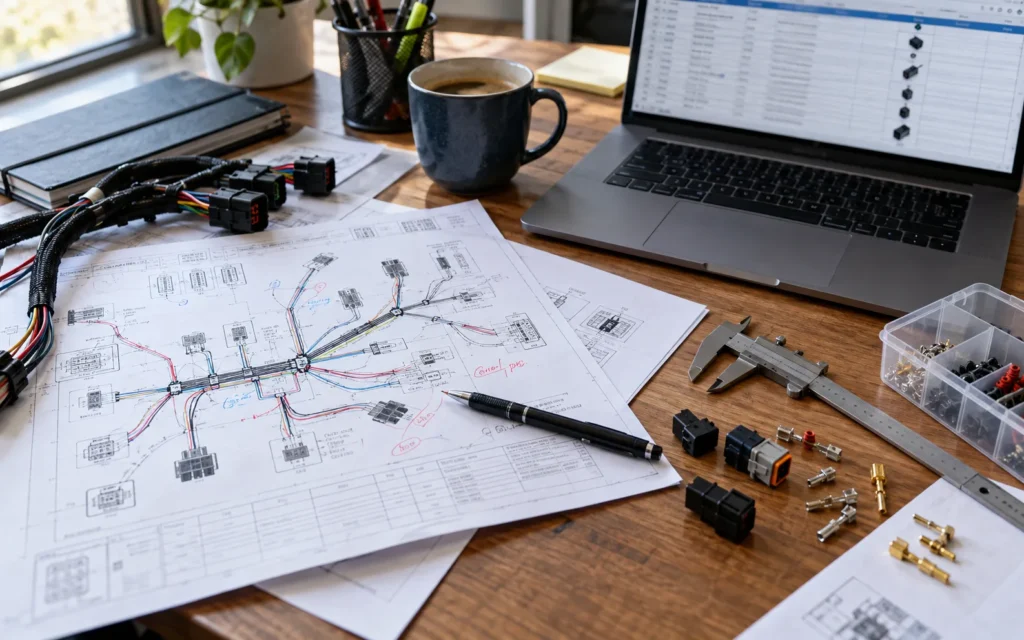
The fastest way to get an accurate wire harness quote is to send a complete package the first time. Most delays happen because a drawing is missing a wire gauge, a BOM lists a connector with no mating terminal, or nobody mentioned the operating environment until after the quote was issued. This checklist covers what a manufacturer needs and how to organize it.
1. A clear drawing or print
Your drawing is the source of truth for the build. A useful harness or cable assembly drawing shows:
- Every wire, with a unique wire number or circuit ID
- Wire gauge, insulation type and color for each conductor
- Cut length for each wire, with the tolerance called out
- Connector and terminal callouts at both ends, with pin or cavity positions
- Branch points, breakout locations and overall dimensions
- Protective coverings such as tape, sleeving, braid or conduit, and where they start and stop
- Labeling requirements, including position and format
If you do not have a formal print yet, a marked-up sketch, a wiring diagram or a sample harness can be enough to start a conversation. Tell us what you have and we will work from there.
2. A complete bill of materials (BOM)
The BOM should list every component that goes into the assembly. For each line, include the manufacturer, the manufacturer part number and the quantity per assembly. Watch for these common gaps:
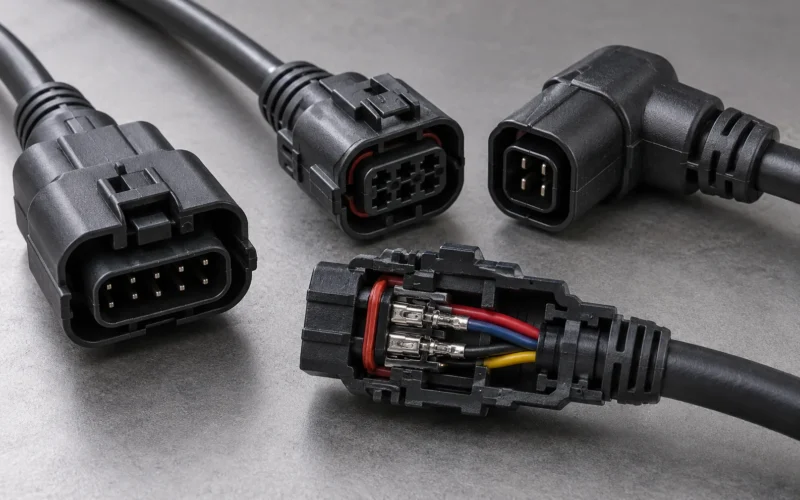
- Connectors without terminals. A housing needs the right contacts, and often seals, wedges or backshells too.
- Wire without a spec. “18 AWG red” is not enough. Include the insulation type, temperature rating and any spec the wire must meet.
- Unclear alternates. If a substitute is acceptable, say so. If it is not, say that too.
- Customer-supplied parts. Note which items you will send us and which we should source.
3. Quantities and timing
Tell us your expected quantity for the first order and your annual volume if you have a forecast. Pricing changes with volume, and knowing whether you need five prototypes or five thousand production units changes how we plan the build. Include your target delivery date so we can tell you early whether it is realistic.
4. Application and environment
A short description of where the assembly lives helps us recommend the right materials. Mention temperature range, exposure to moisture, oil, chemicals or UV, vibration, and whether the assembly flexes or moves in use. These details often point to a better jacket, a sealed connector or an overmolded strain relief that your drawing alone would not reveal.
5. Quality and documentation requirements
If your program calls for a specific workmanship standard, test method or documentation package, include that up front. Continuity testing, hipot testing, pull testing, first article inspection and traceability records all take time and affect price, so they belong in the quote rather than being added later.
File formats that work
Do not worry about the perfect format. PDF drawings, wiring diagrams, spreadsheet BOMs, and clear photos of a sample harness all work well. Our contact form accepts PDF, JPG, PNG, Word, Excel and CSV files up to 10 MB. If your files are larger or in a native CAD format, mention it in your message and we will arrange another way to send them.
Drawing or sketch, complete BOM with manufacturer part numbers, estimated quantities, target date, application environment, and any quality or testing requirements.
What if my package is not perfect?
Send it anyway. An engineer will review it and come back with specific questions rather than leaving you to guess what is missing. This kind of early review is often where the biggest savings appear, such as swapping a hard-to-source connector for a stock alternative or simplifying a branch layout.
Ready to get a quote? Use the button below to send your files or describe your project, and we will respond with a quote and any questions we have.