
If you have ever sent a request for quote that says “harness” when you meant “cable” (or the other way around), you are in good company. The two terms get swapped constantly, even between engineers. But they describe different products with different construction, different cost drivers and different jobs to do. Getting the term right at the start makes your quote faster and more accurate.
What is a wire harness?
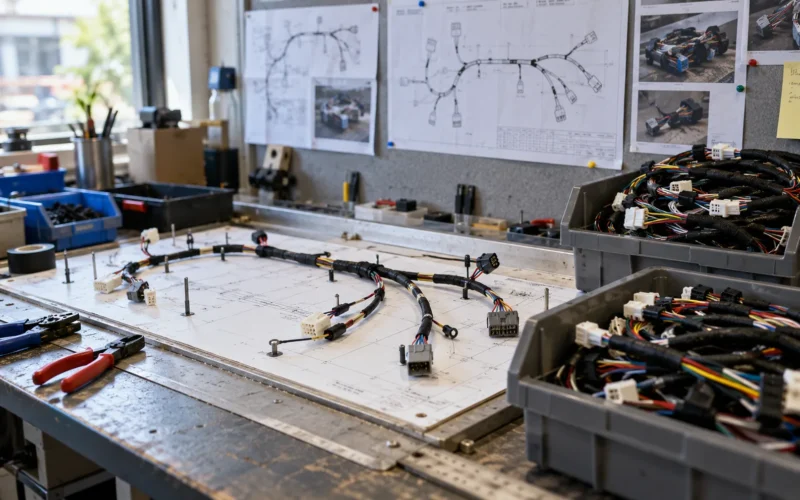
A wire harness groups individual wires and circuits into an organized, routed bundle. The wires are typically held together with tape, sleeving, conduit or cable ties, and each branch ends in a connector, terminal or splice. The harness is designed around the product it lives in: it follows a specific path, breaks out at specific points and is built to a drawing that shows every wire, length and termination.
Harnesses usually live inside a protected space, such as a control panel, an appliance, a machine cabinet or a vehicle interior. The enclosure does most of the protecting, so the harness itself is built for organization, repeatability and ease of installation.
What is a cable assembly?
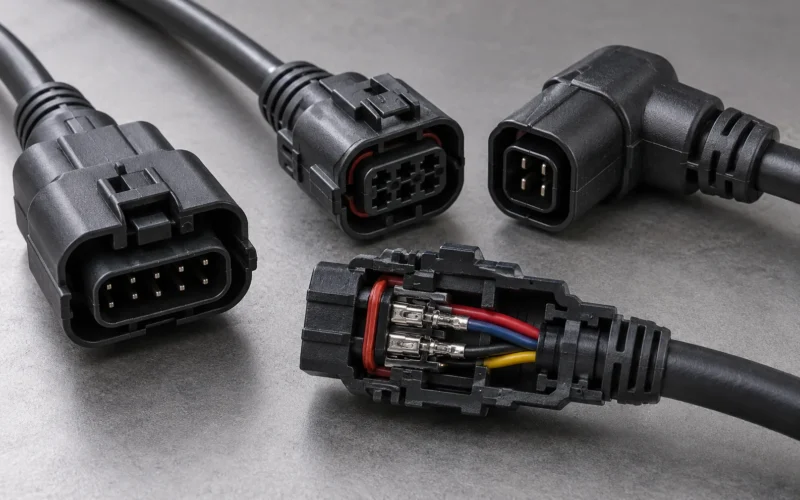
A cable assembly wraps one or more conductors in a shared outer jacket or sheath, then terminates the ends with connectors or other hardware. That jacket is the defining feature. It shields the conductors from moisture, abrasion, chemicals and vibration, and it lets the assembly survive conditions a loose wire bundle could not.
Cable assemblies are the right call when the product runs outside a protected enclosure or needs to move: robotics, trailers, agricultural equipment, outdoor lighting and portable industrial machinery are typical examples.
The practical differences at a glance
- Protection: harnesses rely on the enclosure and secondary sleeving; cable assemblies carry their protection with them in the jacket.
- Routing: harnesses are shaped to a specific path with multiple branches; cable assemblies are usually point-to-point runs.
- Flex life: cable assemblies can be engineered for repeated bending, coiling or twisting; harnesses are generally installed once and left alone.
- Environment: cable assemblies handle wet, dirty or abrasive conditions more readily; harnesses suit dry, contained spaces.
- Complexity: harnesses can have dozens of circuits and many branches; cable assemblies tend to have fewer conductors in a single run.
A few everyday examples
A washing machine has a harness that ties together the control board, motor, door lock and water valves, all inside the cabinet. A boat trailer has a cable assembly running to the lights, built to shrug off water, salt and road vibration. A robotic arm uses a high-flex cable assembly that bends thousands of times a day. Same basic ingredients, very different construction, because the jobs are different.
If your wires live inside a box and need to be organized, you probably need a harness. If they leave the box, move or get exposed to the elements, you probably need a cable assembly.
When you need both
Many products use both. A piece of factory equipment might have an internal harness in the control cabinet and jacketed cable assemblies running out to sensors, motors and operator stations. In that situation it often makes sense to source them from one supplier, so connectors, wire types and test methods are consistent across the whole system.
How the choice affects cost and lead time
Harnesses tend to be driven by labor: the number of circuits, the number of branches, and how much hand routing and taping is involved. Cable assemblies tend to be driven by materials and process: jacket type, shielding, and any overmolded strain relief or molded connectors. Knowing which category you are in helps you predict where the price comes from and where a design change can reduce it.
How to describe what you need
You do not have to settle the terminology before you contact a manufacturer. What matters is describing the application: where the assembly is installed, whether it moves, what it is exposed to, and how many circuits and connectors are involved. A good manufacturer will help you land on the right construction and flag any place where a small change, such as a different jacket or an added strain relief, would improve reliability.
If you are not sure which side of the line your project falls on, send us your drawing or a short description of the application. We will tell you what we would build and why.