
Getting a first prototype harness working is a milestone. Turning that harness into something you can build hundreds or thousands of times, consistently and at a predictable cost, is a different project. Teams that plan for the transition early avoid most of the painful surprises. Here is a practical path.
Stage 1: Build the prototype to learn, not to finish
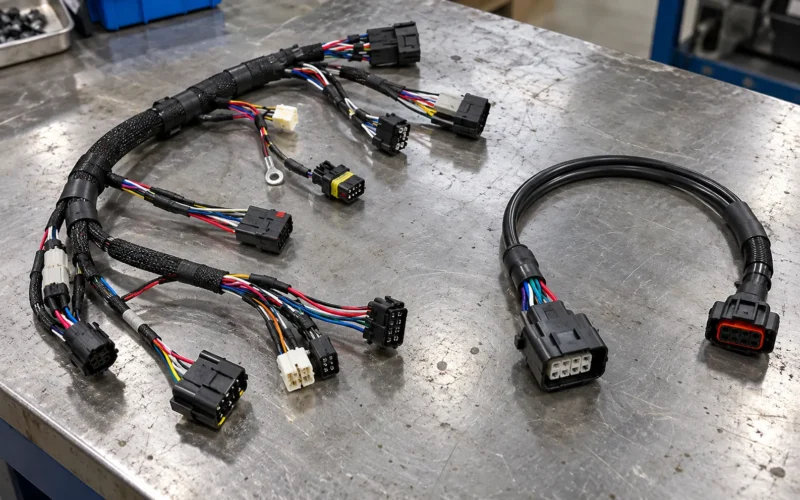
Early prototypes exist to answer questions. Does the harness fit? Do the connectors mate? Is the routing practical for an installer? Quick-turn, low-volume builds are ideal here, because the goal is speed and feedback. Expect to revise the design. Record what you learn as you go: what was hard to assemble, what did not fit and what you would change.
Stage 2: Design for manufacturability
Before you lock the design, have a manufacturer review it. A design-for-manufacturability (DFM) review looks at the drawing and BOM through the eyes of the people who will build it. Typical findings include:
- Connectors or terminals with long lead times or single-source risk
- Wire lengths and branch layouts that make assembly slow or error-prone
- Tight tolerances that add cost without functional benefit
- Missing details in the drawing that would otherwise be interpreted differently by different builders
- Opportunities to standardize wire gauges, terminals or sleeving across the design
Small changes at this stage cost almost nothing. The same changes after tooling and inventory are in place cost a great deal.
Stage 3: Lock the documentation
Production runs on documents. Before scaling, make sure you have a released drawing with a revision control process, a complete BOM with manufacturer part numbers and approved alternates, workmanship and test requirements, and labeling and packaging instructions. A drawing that lives in someone’s head or on a whiteboard will not survive a change of builders or a jump in volume.
Stage 4: Pilot run and first article
A pilot run builds a small batch using the production process and materials, not prototype shortcuts. A first article inspection then checks a finished unit against every requirement on the drawing. This is where hidden assumptions surface, and it is far better to find them on a pilot batch than in your first full order.
Stage 5: Set up for repeatability
At volume, consistency matters more than speed. Automated cutting, stripping and crimping reduce variation, testing fixtures verify every unit, and documented process controls make sure the hundredth harness matches the first. Plan for a test fixture early, since a proper continuity and hipot setup is one of the best investments in a production program.
Stage 6: Plan supply and volume flexibility
Once the design is stable, look at the supply side. Identify long-lead components, decide where to hold buffer stock, and agree on how forecasts will be shared. Ask how the program handles a sudden change in demand, up or down, so you are not caught out later.
Setting realistic expectations
Prototype builds are usually quick, while production setup takes longer: sourcing components, building test fixtures, and completing first article approval. Build that into your schedule rather than assuming the prototype timeline repeats. Share your target launch date early, and work backward from it together with your manufacturer so the milestones are realistic.
Waiting until the design is “finished” to talk to a manufacturer. The best time to involve production is while the design can still change easily.
Keep the same partner through the whole path
Working with one supplier from prototype to production keeps knowledge in one place. The people who built your early units understand the quirks of your design and can carry that forward into volume. If you are planning a new harness program, get in touch with your prints, your target volumes and your timeline, and we will help you map the steps from first build to full production.