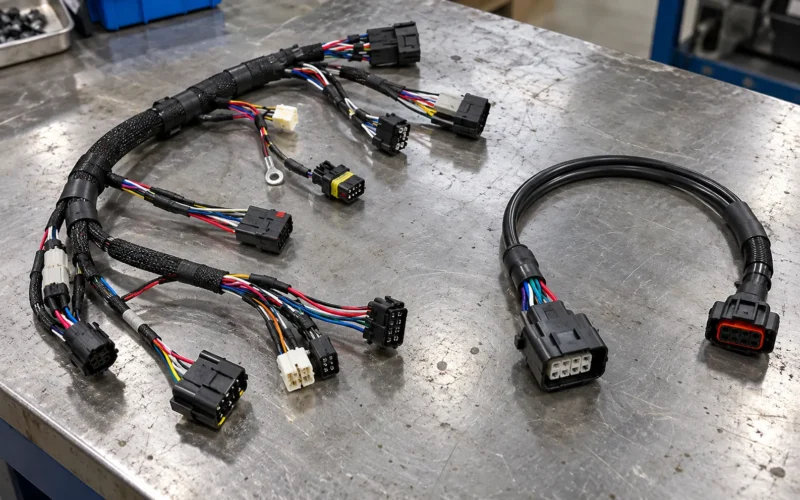
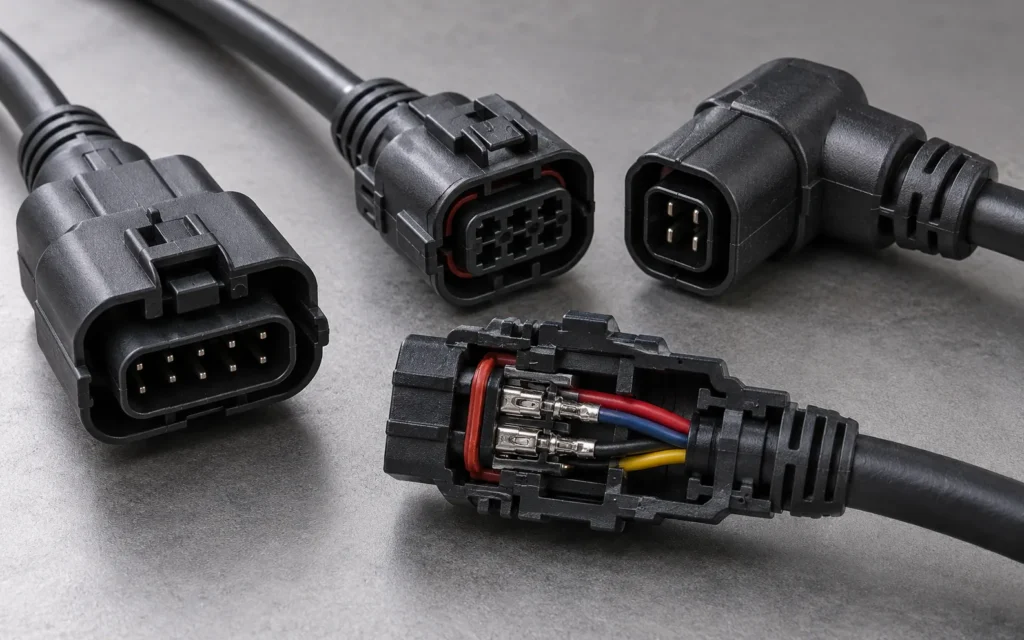
The point where a cable meets a connector is where many assemblies fail. Repeated flexing concentrates stress there, and moisture, dust and chemicals find their way in. Overmolding solves both problems by forming a protective layer of material directly around the connector and cable transition. Choosing how to do it depends on your application, your volume and your budget.
What overmolding does
- Strain relief: spreads bending stress along the cable rather than concentrating it at the termination
- Sealing: blocks moisture, dust and many chemicals from reaching the terminals
- Pull strength: adds mechanical retention at the connection
- Durability: protects against abrasion, impact and vibration
- Appearance and ergonomics: provides a clean, consistent shape and a place for branding
The main process options
Injection overmolding
Molten thermoplastic is injected into a closed mold around the connector and cable. Materials commonly include PVC, TPE and TPU. This is a well-established process that delivers durable, repeatable parts, and it suits programs with steady volumes. It requires a custom mold, so tooling cost and lead time are part of the equation, and the higher pressure involved needs to be compatible with your connector and internal components.
Low-pressure molding
Low-pressure molding uses a hot-melt material, often a polyamide, injected at much lower pressure than conventional injection. That gentler process makes it a good fit for delicate components and assemblies with sensitive electronics, and it can provide excellent sealing. Tooling is typically simpler, which can help with lower volumes and faster starts.
Heat shrink and adhesive-lined boots
Not every application needs a molded solution. Adhesive-lined heat shrink or pre-formed boots can add meaningful strain relief and sealing at low cost and with no tooling. They are a sensible choice for prototypes, low-volume runs and moderate environments.
How to choose
Work through these questions in order:
- What is the environment? Constant washdown, submersion or chemical exposure calls for a fully sealed mold. Occasional splash may not.
- How much will it flex? High-flex applications benefit from a geometry that gradually transitions stiffness along the cable.
- What is the volume? Higher volumes justify tooling investment. Low volumes often favor simpler processes.
- What are you molding around? Sensitive components may rule out higher-pressure processes.
- What does it need to look like? Shape, color, texture and markings can all be built into a mold.
- How compatible are the materials? The mold material must bond properly to the cable jacket and connector body, or the seal will not hold.
Testing an overmolded part
A mold that looks good is not automatically a mold that works. Ask how the finished part will be verified. Pull testing checks retention, flex testing checks the strain relief, and electrical testing confirms nothing was disturbed during molding. If sealing is critical, agree on an environmental test that matches your real conditions, such as water or dust exposure, and put it in the requirements.
Tell your manufacturer about overmolding early. Connector choice, jacket material and even the cable diameter affect how well a mold will bond and seal, and it is much easier to adjust these before tooling is cut.
Common pitfalls
Poor bonding between the mold material and the jacket is the most frequent problem, usually from incompatible materials or surface preparation. Others include over-designing a mold for a low-volume program and forgetting to test the finished part. Pull testing and, where sealing matters, environmental testing confirm the mold does its job.
Talk to us before you commit to tooling
Overmold tooling is an investment, and the right choice depends on the details of your assembly. Send us your connector, your cable and a description of the environment, and we will help you compare the options and pick the approach that fits your program.